


The Future of Indian Crafts – Part 4
Storytelling: How Art Becomes an Experience We Carry Home
What do visitors carry home from the Taj Mahal?
Photographs, certainly. Memories of its marble, symmetry and extraordinary workmanship. But accompanying those images is a story: Shah Jahan built this mausoleum in memory of Mumtaz Mahal. The architecture acquires a human dimension through love, loss and remembrance.
That story travels across countries and generations. It gives people something to anticipate before a visit, something to feel while standing before the monument, and something to share afterwards. It can also give them a reason to return—to revisit a feeling as much as a place.
For Indian craft, there is an important lesson here. Beauty attracts attention. A meaningful story gives that attention somewhere to go.
In the earlier articles of this series, we discussed relevance, artisan succession, and architects and interior designers as potential custodians of craft. Storytelling connects these concerns. It helps people understand why a work matters, why its details deserve attention, and why it belongs in their lives today.
An unfamiliar object asks the viewer to do a great deal of work. Who is depicted? Why this posture? What makes this material or technique significant? A thoughtful story offers a way in. It creates curiosity, gives details meaning and makes the encounter easier to remember and share.
What museums help us see
The British Museum presents the Rosetta Stone through the story of decipherment: how its inscriptions helped scholars recover the ability to read Egyptian hieroglyphs. Its exhibition Hieroglyphs: Unlocking Ancient Egypt built on that journey of discovery. British Museum
A visitor who initially sees an inscribed stone can begin to recognize an object that helped reopen access to an ancient civilization's written world. The story gives the act of looking a purpose.
At the Van Gogh Museum, the explanation of Almond Blossom introduces another kind of connection. Van Gogh painted it for his newborn nephew; the museum relates its blossoms to the promise of new life. Knowing this, a viewer can encounter the painting as an expression of affection and hope, alongside its colour and composition. vangoghmuseum.nl
To me, these examples show how interpretation can create reasons to visit, linger, discuss and return. A museum becomes relevant when people can find a connection between what is displayed and something they can understand or feel.
Our craft traditions offer an equally rich opportunity.
When a dancing form becomes a story
Consider a depiction of Lord Shiva performing Urdhva-Tandava, with one leg raised high.
Without an explanation, a viewer may recognize Shiva as the Lord of Dance and admire the energy of the pose. Yet the particular episode represented can remain unnoticed.
In one traditional account, Shiva and Goddess Parvati engage in a dance contest, matching each other’s movements. Shiva then performs Urdhva-Tandava, raising his leg high. Parvati, observing the modesty described in that telling, chooses not to repeat the posture and yields the contest (Other regional retellings identify the competing goddess as Kali).
The story directs attention back to the art. The raised leg becomes the decisive moment in a narrative. The viewer begins to look for how the artist has expressed movement, tension and response.
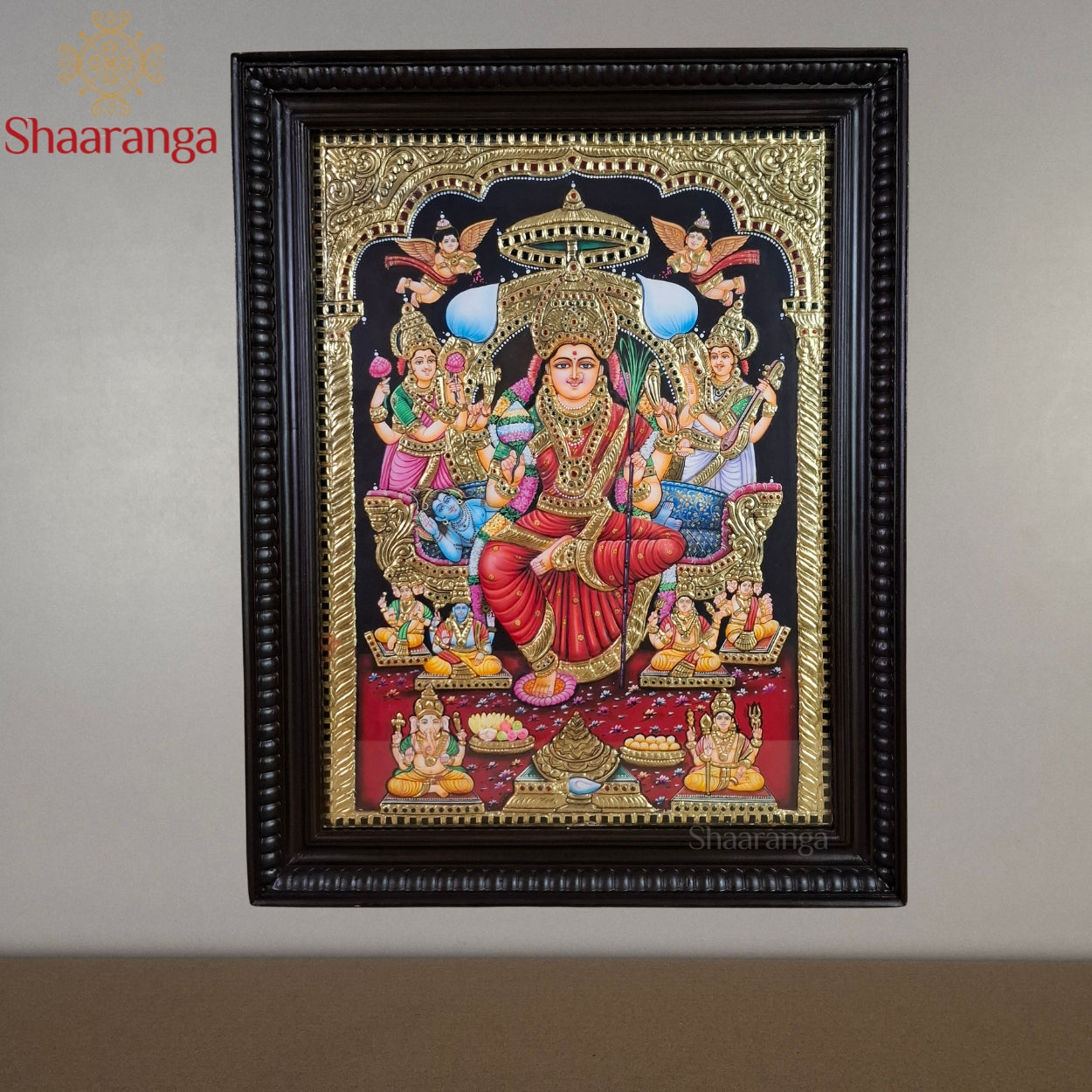
In a Tanjore painting of this subject, the pleasure of colour, gold and workmanship is joined by the pleasure of understanding. The owner now has a story to share whenever someone pauses before it.
The distinction matters: the dance contest belongs to this particular narrative tradition; it is not the explanation for every Nataraja image.
The stories held within Odisha’s palm leaves
Odisha’s palm-leaf paintings and engravings offer another compelling example. These works belong to a tradition of illustrated storytelling, including manuscripts depicting episodes from the Ramayana and various stories of Lord Krishna.
At first glance, a buyer may admire an intricate arrangement of figures and fine lines. But how much more becomes visible when someone identifies the characters, explains the episode and helps the viewer follow the sequence?
What appeared to be an elaborate pattern becomes a narrative that can be read through images. Small gestures gain meaning. Relationships between scenes become clearer. The delicacy of the execution can be appreciated alongside the artist’s ability to organize a complex story within a limited space.
For a buyer unfamiliar with this visual language, explanation can make the difference between passing admiration and recognizing a work worth acquiring and cherishing.
These are precious cultural expressions. Their richness deserves to be made accessible to the people who may become their custodians.
What we have experienced at Shaaranga
At Shaaranga, some of our Instagram content on Tanjore art has achieved reach of around 1.5 million. Our storytelling around the exceptional Sandalwood Ganesha we created has brought a different kind of response: attention from potential customers drawn to such extraordinary work. Other stories have prompted particularly curious questions.
These experiences have convinced me that the value of storytelling cannot be judged by reach alone. A widely viewed story can introduce a tradition to new audiences. A more focused story can help a discerning patron recognize a creation’s significance. A question can be the beginning of a lasting interest.
What matters is whether people leave with a deeper understanding of the work.
How understanding strengthens value
When a customer knows very little about an artifact, readily visible features—size, material, colour and price—may dominate the comparison. Storytelling expands what they can recognize: the meaning of the form, its historical context, the skill of its execution and the thought behind its creation.
That understanding can strengthen the case for a premium grounded in genuine quality and distinction. The story must remain faithful to the work. Accuracy, credible provenance and respect for the artisan make appreciation durable.
Present-day adaptation is part of this story too. A palm-leaf narrative can become a carefully presented focal point in a contemporary interior. A traditional painting can give a modern home a connection to its family’s cultural memory. Thoughtful scale, framing, lighting and placement can help an older visual language remain accessible without stripping away its identity.
This gives designers and craft businesses a practical responsibility: explain the connection between a work’s origins and the life it can have today.
Eventually, the artwork must speak for itself. No curator, artisan or gallery owner can remain beside it forever. A good introduction allows its story to stay with the owner, who can discover more, share it with guests and pass it to the next generation.
The next article will explore how this appreciation can support sustainable livelihoods for the people who keep our craft traditions alive.
A work of art carries a story within it. When we help people understand that story, we give them something to carry home—and something that continues to speak long after we have stepped away.